Measuring What Truly Matters
Many non-profit organisations are measuring activity but struggling to understand impact. We count:
- Workshops conducted.
- People trained.
- Reports submitted.
- Funds spent.
These numbers are important. They demonstrate effort and accountability. But they do not always tell us whether lives are improving, trust is growing, or communities are becoming more resilient. As Albert Einstein reportedly observed:
“Not everything that counts can be counted, and not everything that can be counted counts.”
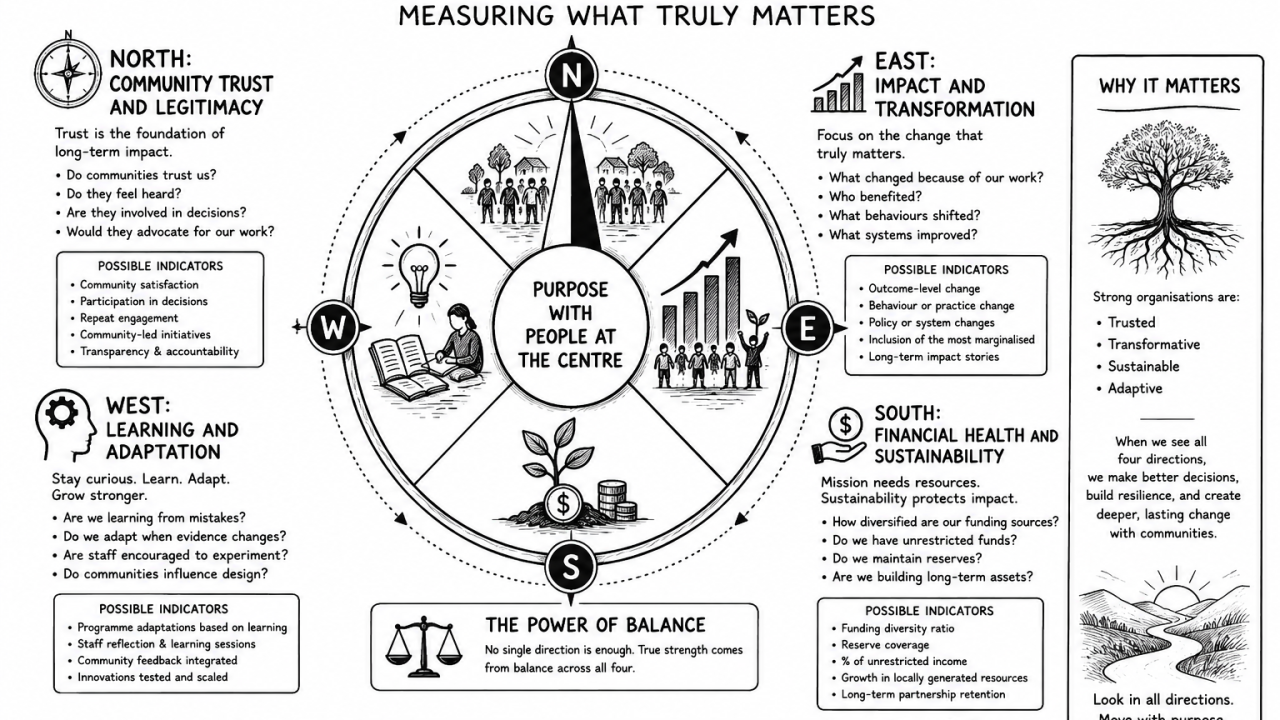
This month, we explore the Four Directions Dashboard (FDD) — a values-based framework for measuring organisational health and impact more holistically. The Four Directions Dashboard helps organisations move beyond compliance-driven measurement and toward learning, accountability, and transformation.
Why We Need a Different Dashboard
Most performance systems in the development sector were designed to answer donor questions:
- How many?
- How much?
- How fast?
These are useful questions. But communities often ask different questions:
- Do we trust you?
- Has our situation improved?
- Are we stronger than before?
- Will this change last?
Traditional measurement systems often struggle to capture these dimensions. The Four Directions Dashboard was developed to help organisations balance technical accountability with human-centred learning.
Understanding the Four Directions
Imagine standing at the centre of a compass. To navigate effectively, you must understand all directions, not just one. Similarly, strong organisations need visibility across four interconnected dimensions:
- North: Community Trust and Legitimacy
- East: Impact and Transformation
- South: Financial Health and Sustainability
- West: Learning and Adaptation
Together, these four directions provide a fuller picture of organisational performance. North: Community Trust and Legitimacy: Many organisations focus heavily on delivering services but spend less time measuring trust. Yet trust is often the foundation of long-term impact. Communities may participate in programmes because resources are available. But genuine transformation requires confidence, ownership, and legitimacy. Ask:
- Do communities trust our intentions?
- Do they feel heard?
- Are they involved in decisions?
- Would they advocate for our work?
Possible indicators:
- Community satisfaction levels.
- Participation in decision-making processes.
- Repeat engagement.
- Community-led initiatives emerging from programmes.
- Perceptions of transparency and accountability.
Trust grows slowly but can disappear quickly. Without legitimacy, sustainability becomes difficult. East: Impact and Transformation: This direction focuses on the actual change being created. Many organisations stop at outputs:
- Number trained.
- Materials distributed.
- Meetings conducted.
The Four Directions Dashboard pushes further. Ask:
- What changed because of our work?
- Who benefited?
- What behaviours shifted?
- What systems improved?
Examples: Instead of: 500 youth trained. Ask: How many secured employment, started businesses, or became community leaders? Instead of: 20 advocacy meetings held. Ask: What policy, practice, or behavioural changes resulted? Transformation matters more than activity.
South: Financial Health and Sustainability: Many non-profits avoid discussing financial sustainability because it feels uncomfortable. Yet mission without sustainability is fragile. An organisation constantly worried about survival struggles to focus on transformation. The South Direction examines organisational resilience. Questions include:
- How diversified are our funding sources?
- How much unrestricted funding do we have?
- Do we maintain reserves?
- Are we building long-term assets?
Possible indicators:
- Funding diversity ratio.
- Reserve coverage.
- Percentage of unrestricted income.
- Growth in locally generated resources.
- Long-term partnership retention.
Financial sustainability is not about accumulating wealth. It is about protecting mission continuity. West: Learning and Adaptation: The development sector often rewards certainty. But real change happens in complex environments where certainty is impossible. Organisations must learn continuously. The West Direction focuses on adaptability. Ask:
- Are we learning from mistakes?
- Do we adapt when evidence changes?
- Are staff encouraged to experiment?
- Do communities influence programme design?
Possible indicators:
- Number of programme adaptations based on learning.
- Staff reflection sessions conducted.
- Community feedback integrated.
- Innovations tested and scaled.
Learning organisations survive turbulence better than rigid organisations
The Power of Balance
One of the biggest risks organisations face is overemphasising one direction.
For example:
- High Impact, Low Sustainability: Programmes perform well, but funding is unstable.
- Strong Finances, Weak Community Trust: Resources grow, but legitimacy declines.
- Strong Learning, Weak Results: Reflection happens, but implementation lags.
- Strong Trust, Weak Systems: Communities support the organisation, but operational weaknesses limit effectiveness.
Balance matters. A healthy organisation pays attention to all four directions.
From Reporting to Learning
Many dashboards become compliance tools. The Four Directions Dashboard is different. Its purpose is not simply to report upward. Its purpose is to learn inward and improve outward. This shift changes conversations.
Instead of asking: Did we hit the target?
We ask: What are we learning?
Instead of asking: How many activities did we complete?
We ask: Are we becoming more effective, trusted, sustainable, and adaptive?
Gather your leadership team.
Discuss:
- Which direction is strongest?
- Which is weakest?
- What imbalance concerns us most?
- What one action can strengthen each direction?
This simple exercise often reveals blind spots.
Why This Matters for the Global Majority
Many organisations across Africa, Asia, Latin America, and the Pacific operate under intense pressure to demonstrate measurable results. The danger is that measurement becomes detached from meaning. The Four Directions Dashboard offers a different approach. It recognises that successful organisations are not merely productive.
They are:
- Trusted.
- Transformative.
- Sustainable.
- Adaptive.
These qualities are essential for long-term impact.
Reflection
A dashboard should not simply tell you how fast you are moving. It should tell you whether you are moving in the right direction. The Four Directions Dashboard reminds us that organisational success is multidimensional.
- Community trust matters.
- Impact matters.
- Financial sustainability matters.
- Learning matters.
When all four directions are visible, leaders make better decisions, organisations become more resilient, and communities experience deeper and more lasting change.
Charles Kojo Vandyck
is a development practitioner, author, and podcaster specializing in civil society strengthening, systems change, and locally led development. They provide strategic guidance, training, and coaching to civil society groups, funders, and development agencies advancing social justice, humanitarian priorities, and environmental causes.
A certified Change the Game Academy Master Trainer and IFC-LPI Trainer, [Name] equips leaders with skills in governance, leadership, and financial sustainability. Their extensive governance portfolio includes board roles at GenCED, Connective Paths Foundation, and Axiom Institutional Systems, as well as co-chairing the Pledge for Change Global Advisory Panel and serving on the Core Team for the RINGO initiative. They remain dedicated to fostering resilient, locally rooted organizations driving people-centered change across the global majority.
Network Weaver is dedicated to offering free content to all – in support of equity, justice and transformation for all.
We appreciate your support!