This series is building toward a hypothesis that has motivated my work: that governance itself is a strategic leverage point for bringing how we operate into attunement with the interconnected living world we actually navigate.
Much of what we have inherited as governance carries an industrial-hierarchical logic — command and control, org charts, containment — based on a paradigm that is losing ground in the collective narrative.
Within a living systems paradigm, the shape governance takes is nested, membraned, adaptive, and continually in flow. Governance, power, and resources circulate rather than concentrate; and self-governance is grounded in sensemaking and adaptation, rather than control. A reorganization of this kind is not the means to a structural shift. It is a structural shift.
The relational scale is where the bones of that shape first become visible. The hope that fuels my commitment is that, in a world of complex adaptive systems, as adrienne maree brown writes, small is all. The transformation we are reaching for does not depend on a big plan. In complex systems, big plans often do more harm than good. Small strategic moves have nonlinear, outsized effects. The intentional behaviors we practice ourselves and in small groups ripple
The seed of life
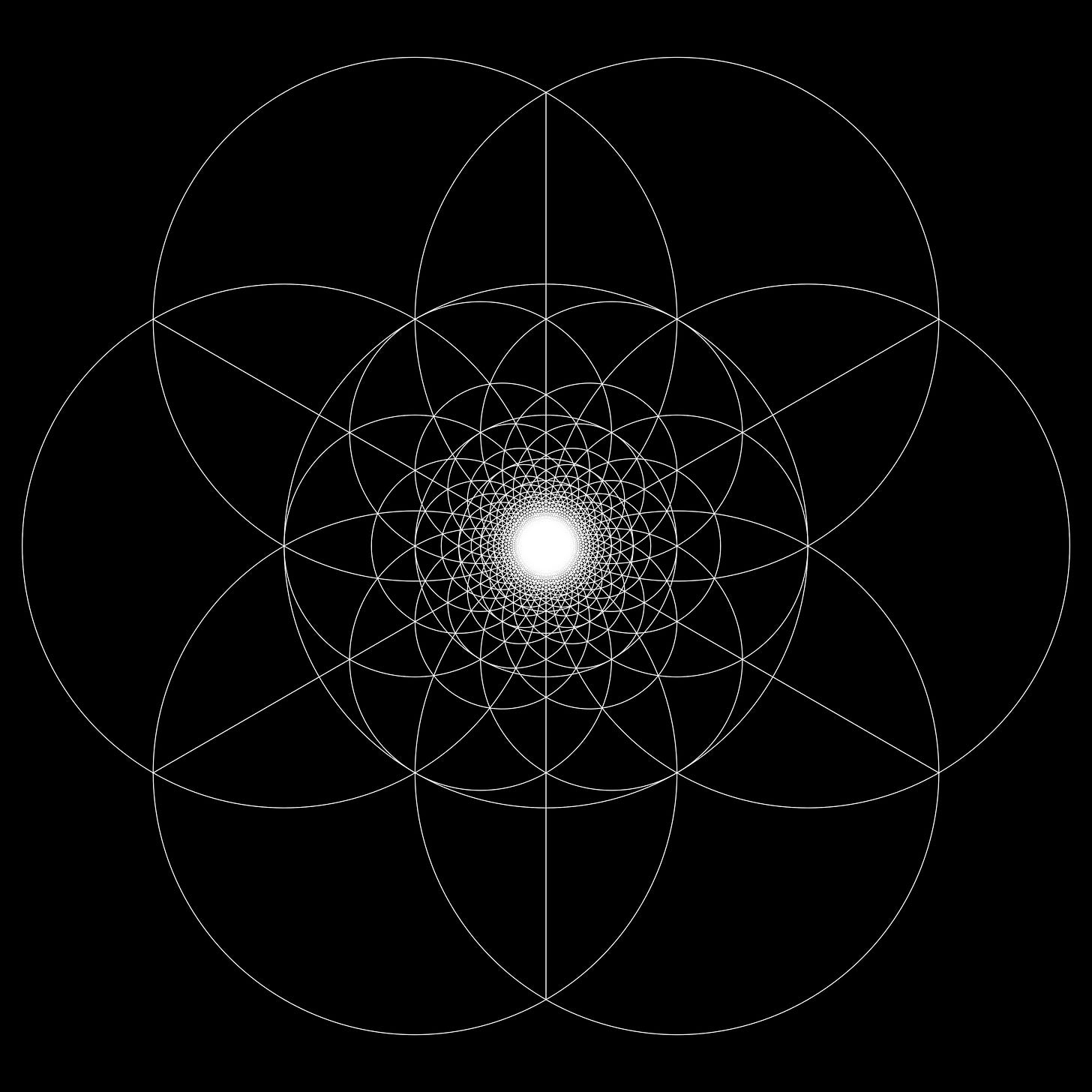
A shape that holds this at the relational scale is a kind of stylized torus — a two-dimensional figure standing in for what is in motion. The overlaps you see on the page are flows in a living team: across membranes, inward and outward, continuously. In sacred geometry, the figure is called a Seed of Life: overlapping circles forming a unit that is itself a whole, and that nests within larger wholes. In secular terms, it represents the interconnectedness a Venn diagram can only hint at.
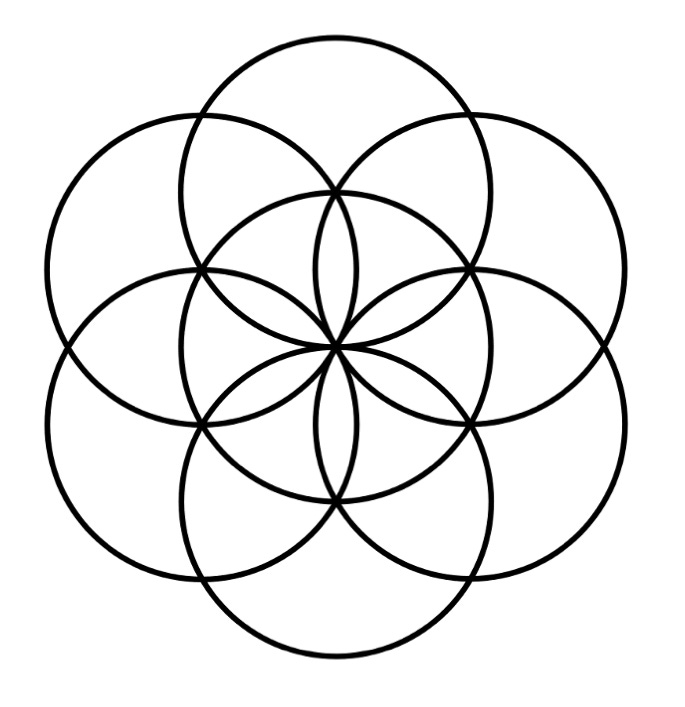
Classically the seed of life is six circles around a seventh, but seeds appear in many configurations — two, three, four, five, more — and the pattern’s integrity is in the overlap rather than the count. From a governance lens, the overlap is where shared purpose lives. So a pair is a seed of life; a trio is a seed; a small team is a seed; a congregation is a seed.

The self as a seed of life
The nesting runs inward as well: a single person is also a seed of life. Sociologists, IFS therapists, and practitioners in many other traditions have arrived at similar insights from different directions. Audrey Tang would call this the plural self, the person as a unique crossing point of social circles. Richard Bartlett would call it the self-as-a-group, a network of overlapping identities sharing custody of one body. The seed of life makes visible the same claim geometrically.
The Welsh word cynefin — borrowed by Dave Snowden for his complexity framework — names this directly: the multiple places that have made us, the constellation of belongings each of us carries. He could not find a comparable word in English. Each of us is multicultural across families, workplaces, friend groups, communities, and watersheds, responding to norms and rules that are distinctive to each. Like a fingerprint, nobody else carries the exact overlap of edges that you do.
This same multiplicity lives inward, too. Each of us holds multiple ways of sensing and knowing — intuition, feeling, embodied sensing, analytical thought — systems nested within the self as a system. Black and Indigenous practitioners have held this in plain view for generations. Elissa Sloan Perry and Aja Couchois Duncan of Change Elemental named multiple ways of knowing as central to advancing love, dignity, and justice — naming what dominant Western institutions have long pushed underground. Russ Gaskin, Luzette Jaimes, and Ana Lucía Castaño Galvis have articulated four ways of inner knowing — cognitive, emotional, somatic, intuitive — as woven together within whole selves rather than competing within them. Eugene Gendlin’s Focusing gives us a practice for listening to felt sense, one of the somatic channels of this knowing.
Lana Jelenjev translates two concepts from Filipino psychology — Sikolohiyang Pilipino — into contemporary facilitation practice: kapwa, the shared inner self we hold with others, and pakikiramdam, a practice of deep, attuned sensing that moves across multiple layers — interoception and felt sense, proprioception and nervous-system awareness, and what she calls sensing the between: the relational field, the quality of the space between people.
Stephen Porges’ polyvagal work has filtered into the field as the language of self-regulation and co-regulation we now use in trauma-centered facilitation. (An aside: I enjoy using the term regulation here because of its association with governance — it feels playful to me. Other people use the term attunement, which has a musical quality, as in team members attuning to each other and themselves. I use both.)
When I say the seed of life is a unit at the relational scale, I mean it in both directions: outward, the many communities we are woven into and with (including non-human ones, as Robin Wall Kimmerer reminds us, where kin extends well beyond the human); and inward, the many ways of sensing and knowing woven through us.
The team as a seed of life
The same pattern holds when we move from the person to the team. A small group of three or four or seven is itself a seed of life, and each person within it is also a seed of life. Even in this complexity, at this scale, a group can stay coherent through the relationships themselves — through trust, shared context, and direct conversation.
A great example is the World Cafe facilitation method. The structure is basically conversational tables of four to six seats and powerful questions at each table. Then people change tables and are seated in a different small group. It can scale to thousands of tables of participants and stay intimate and relational with a very light structure anyone with basic skills can facilitate.
Even at the top of corporate hierarchies, boards are often kept intentionally small for nimbleness in decision-making, or small executive teams emerge as the real seat of decision-making.
Richard Bartlett calls this scale the crew and names it as the seat of activity in microsolidarity practice. His social physics of belonging confirms what sociocratic practitioners and many of us in collaborative governance have long known: decision-making at the small-team scale is optimal, as long as the team is communicating and testing their decision-making with others who are impacted, and they are willing to adapt to that feedback.
What lets a team function as a seed of life
What lets a team function as a seed of life is not the geometry. The geometry is a placeholder for structures that maintain the integrity of purpose, interconnection, and nested wholeness.
Firstly, it is in how we hold diversity and dissonance — curiosity, deep listening, empathy, restorative practice, working with polarities and paradox, mutual consent — and the skill those practices require to mature.
Secondly, a seed of life is fundamentally porous, unlike a Venn diagram. We each arrive in a team already in conversation with our other spaces of belonging — already more or less co-regulating with other communities of meaning we sit within (communities of practice, families, friendships, organizations, faith communities, therapeutic or somatic practices). And we arrive at the team level more or less self-regulating and able to co-regulate with our teammates.
And, we bring what Nora Bateson calls warm data — the relational knowing that comes from being intimate with a context, and multiple contexts, which cold data can never replace.
This is one of the reasons the principle nothing about us without us is not only ethical but structurally necessary. A small team’s capacity to sense the field depends on who is transcontextually connected and how. Intentional membership is not necessarily about inviting everyone into the room; it is about ensuring that the warm data our team needs in relation to its purpose is present in the team itself, alongside a spiral outward that tests decisions with a wider field. This means the team navigates from within the field, not above it.
Thirdly, the torus flowing through the seed of life implies a structure of recursive learning. The team is continuously cycling — inward to make sense of what they are perceiving, outward to test with the field, back inward to integrate what came back, outward again. Each cycle carries two learnings: what the field is telling us in relation to our purpose, and what our own sensing missed the first time. A team that decides once and executes forever is machine-like; a team that senses, decides, tests, senses, decides again is an evolving system. Each cycle changes the team itself, not just its outputs — the sensing capacity grows, the shared context deepens, the warm data becomes richer.
This is a governance capacity industrial-hierarchical structures struggle to hold: decisions calcify into policy, feedback loops get treated as complaints, and the sensing organ atrophies. Governance in toroidal flow means decisions stay in conversation with the field rather than settling into fixed outputs.
The seed of life is to visual language what Transformative Social Systems is to the field of practices. TSS is not a single program, not a branded solution, but a constellation of practices ancient and modern that Laureen Golden and Pascale Mompoint-Gaillard have articulated as a kind of practice-family, oriented toward what Laureen names as the capacity to remain coherent under pressure. Tom Atlee’s Wise Democracy Pattern Language does adjacent work — naming patterns across democratic traditions that support collective wisdom to emerge, without prescribing any single method. Its “prime directive,” or fundamental principle, is to evoke and engage the wisdom and resourcefulness of the whole on behalf of the whole.
The seed of life is a placeholder for this complexity. It does not replace these skills and practices; it makes visible the shape of relationship these practices are tending at the relational scale.
What the person can bring depends, of course, on whether the team is a container capable of receiving wholeness rather than extracting it — a structural question the posts ahead will take up.
Structure that breathes
A colleague once described what happens when governance takes this shape as feeling less like a structure and more like an ecology. That is precisely the reframe I want to name. This is not a soft alternative to structure. It is structure — with membranes, flows, feedback, and integrity — shaped by living systems logic rather than by the mechanical logic many of us were taught to expect. In the next post, we will see that the seed of life nests within the pluricentric Flower of Life. My hope is it offers something that industrial-hierarchical governance has struggled to give networks: a coherence they have been needing.
Karen O’Brien’s insight that we paraphrased in the last piece — you matter more than you think because you are where the system breathes — stops sounding motivational here and starts sounding structural. Governance is not the work of changing systems “out there.” It is how we participate in systems we are already woven into and with, from within them. Every seed of life is one of the breathing pockets in a wider field, taking in and giving back, each nested inside the next layer of the pattern, each nesting other seeds within — nested, but not contained.
Joanna Macy’s lifelong work on the Great Turning has named this for decades. What is needed is not a single heroic move but countless small, faithful turnings toward life, undertaken from the places where people actually are. Margaret Wheatley has long described what happens next as islands of coherence forming across the field, building on what Ilya Prigogine first named in physics.
The image I keep coming back to is a field with pockets opening and breathing — seeds of life — where what feels like a new paradigm is not new but life finding its way back through us. We are not building this from scratch. We are remembering how life has always organized itself, and learning to recognize when we are organs of that remembering rather than obstacles to it.
A register the work asks for now is not new-paradigm triumph but healing — the resumption of flow where flow had been blocked, breath returning to the pockets, life coming back to life through seeds of life — people welcoming themselves and each other into wholeness.
The pieces ahead will move into the architecture that carries this shape — how these seeds nest into networks, how stewardship functions inside the pattern, how power and resources flow through toroidal governance rather than accumulate and obstruct. For readers interested in the bones, more will be revealed. This article has been about the shape of the pattern at the relational scale. The next one builds on it.
Notice where you sit. Notice the seeds you are already part of. Notice that you are one.
As Bayo Akomolafe says: the times are urgent — let us slow down.
Tracy Kunkler
Tracy Kunkler
Tracy Kunkler, MSW, is a Co-Director and Co-Founder of Circle Forward Partners (https://circleforward.us/). She is a professional facilitator who has been providing facilitation, planning and consultation services since 2006, after nearly two decades of community development work in nonprofit and government sectors. Her consulting practice has been with nonprofit organizations and networks at many different levels, from neighborhoods and municipalities, to national landscape conservation, health, food policy networks, and other community development and cross sector networks around the country. Circle Forward and Tracy’s work has been featured in numerous research publications, blogs and podcasts. For leaders and social innovators working in complex systems, Tracy brings the latest research and hard-won experience into your space, to support the co-design of your collaborative governance systems. She provides facilitation, design spaces, and practical tools and frameworks, so that you can engage diverse voices, empower distributed leadership, make decisions, address power dynamics, and adapt and respond to emerging conditions – to bring about more equitable and effective results in large-scale systems change
Original article found HERE
Network Weaver is dedicated to offering free content to all – in support of equity, justice and transformation for all.
We appreciate your support!