by Akash Bhalerao, Ashoka and Russ Gaskin, CoCreative
For anyone wanting to catalyze systemic change, the question isn’t if they need to engage others, but how, and when. Tackling the root causes of complex challenges like climate change, inequality, or public health requires engaging a constellation of stakeholders—from grassroots communities and government agencies to industry-specific companies and global funders. Yet “engagement” is often treated as a single activity, a monolithic task of “getting people on board.”
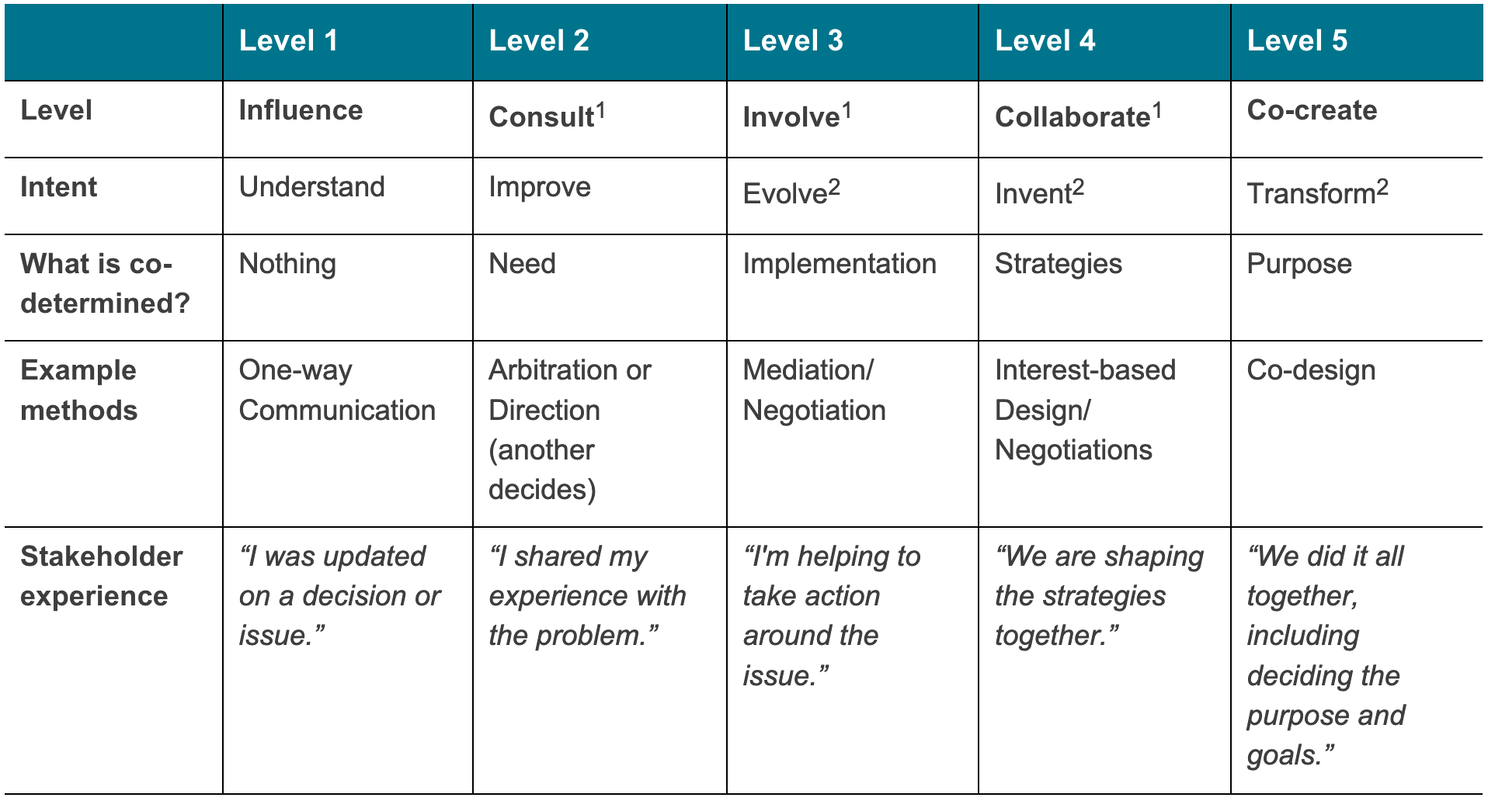
This approach misses a critical strategic dimension. Engagement is not a single act; it’s a spectrum. Based on CoCreative’s adaptation of work by the International Association for Public Participation (IAP2), we can think of engagement as a five-level staircase. Each step represents a different level of stakeholder participation and ownership.
For change to be truly systemic, leaders need to be able to work effectively across all five levels—from influencing and involving many, to co-creating with some.
Referencing case studies from a global cohort of Ashoka Fellows who participated in the Globalizer Program, this article unpacks the Engagement Staircase. It provides a practical framework and real-world examples of how changemakers are intentionally and strategically engaging stakeholders across the levels to catalyze truly systemic change.
The Five Levels of Engagement
Think of the levels like an invitation to bake. At the lowest level, you’re simply offering someone a piece of the cake you’ve already baked. At the highest, you’re in the kitchen together, deciding what to make.
The staircase is not a hierarchy of value, but a way to think strategically about engagement.No single level is inherently “better” than another; the key is to engage with others across levels as needed to realize lasting systemic change. As you move up the staircase, each level of engagement requires a greater investment of time and collaboration support capacity, and the work involves greater complexity. But in return, it leads to deeper shared ownership for systemic impact.
To be able to work at any constellations of levels, you need to have the ability to work at all levels. In our view, the more systemic and complex the challenge, the more we need the capacity to engage at the highest levels. Thus, we need to pay particular attention to our capacity to operate at the highest levels of co-creation—collaboration and co-creation—since these require mindsets and skillsets that are grounded in collaborative leadership, self-awareness, power-sharing and deep listening.
By developing the mindsets and methods to work at all levels, changemakers move beyond buy-in: from leaders engaging others to support their goals, plans, and solutions, to ownership, where these are being developed together. The result: change that is more equitable, more resilient, and more sustainable.
Below are the five levels, with examples of how the Fellows are engaging different stakeholders for different tactics/milestones towards their systems change goals.
Level 1: Influence — “We need to address this issue.”
This is a one-way flow of messaging. The goal is to raise awareness, share knowledge, and build public understanding about the root causes of the problem and the importance and approaches to address it. You are broadcasting a message, not seeking input. It’s the megaphone for your mission.
Examples:
- Open-Sourcing a Methodology. Afforestt used a Kickstarter campaign to fund the creation of open-source YouTube tutorials on their Miyawaki forest-making method to improve the practices used by forest makers worldwide. This influencing tactic codifies and disseminates their knowledge to a global audienceof laypeople, sparking interest and encouraging accurate adoption of their methodology.
- Consistently Creating Awareness. By consistently appearing in mainstream and industry media, Truckers Against Trafficking (TAT) keeps the dialogue on the importance of tackling human trafficking in the societal narrative. In 2024 alone, they secured 127 media mentions, featured on 14 episodes of the Dave Nemo Show (reaching one million industry stakeholders), authored 10 trade articles and 3 industry newsletter pieces, and expanded their reach through 20 podcast appearances, 10 radio/TV interviews, and additional storytelling via blogs and newspapers—establishing themselves as a leading anti-trafficking voice and encouraging sector-wide adoption of best practices.
- Creating a Shared Space for Peer Learning. The Good4Trust team created an open convening space where actors working on alternative economic models can meet, learn from each other, and exert mutual influence. Through the Next Economies Summit, they bring together academia, civil society, media, finance, and grassroots initiatives to enable cross-pollination, build alliances, and strengthen a shared ecosystem driving systemic change toward a socially and ecologically fair economy.
Level 2: Consult — “Please help us understand this issue.”
This is a two-way exchange, but the definition of the problem and the decision-making power regarding the best approaches forward still rests with you. You are actively seeking input, gathering data, and listening to the system to test your assumptions and make better-informed choices about the approaches to address the root causes of the problem.
Examples:
- Conducting Systematic Evidence Collection. For years, the National Association of Street Vendors of India relied on stories of vendor harassment. To influence government action, they adopted a “consult” tactic, conducting in-person surveys with 160 vendors to quantify the problem. This data, collected by listening directly to the community, became the undeniable evidence that opened doors to government agencies acknowledging and working to address the problem.
- Undertaking Formative Research. Before scaling their digital health platform in Nigeria, mDoc conducted “prevalence and photo-voice studies.” This deep form of consultation involved listening to the community to understand their lived reality of chronic disease, ensuring the subsequent solution was truly human-centered.
- Leveraging Peer Networks for Best Practices. To formalize healthcare access for people with rare diseases in Romania, RPWA (Asociația Prader Willi din România) participates in EU-level working groups on rare diseases. This allows them to consult with international peers, learn about best practicesfrom organizations like Eurordis, and then adapt and apply those learnings to the Romanian healthcare system.
Level 3: Involve — “Here’s how you can help clarify and address this issue.”
At this level, you work with stakeholders to ensure their concerns and aspirations are understood and reflected in the solutions and you involve them with the problem solving. They are active partners in shaping the “how,” even if you hold the final decision on how to go about addressing the root causes of the problem.
Examples:
- Piloting and Iterating with End-Users To address the absence of methods to treat motor impairments for young people in Italy with a disability of Cerebral Palsy, FightTheStroke didn’t just test its Mirrorable rehabilitation platform on families; they piloted it with 20 familieswho became “active partners in shaping the solution.” This deep involvement ensured the final product was not just clinically sound but also practical and motivating for children and parents to use.
- Involving Stakeholders in Program Design. Green Savers has been working to make it a norm in Bangladesh to use rooftops for gardens and farming by building the rooftop gardening services market/field. When Green Savers in Bangladesh launched their Urban Garden Academy, they engaged with the government’s Agriculture Extension Office. This engagement involved the government directly in shaping the training curriculum, ensuring its quality and relevance, and building government buy-in from the start.
- Training Stakeholders to Improve Data Collection. The Access Bangladesh Foundation (ABF) and the Bangladesh Bureau of Statistics refined the national census questionnaire to include questions to quantify the number of people with disability. Along with improving the census questionnaire and training the officials, they also trained more than 127 grassroots organizations that support people with disabilitiesaround Bangladesh, to educate the family members of the people with disabilities they serve on how to respond to the questions of the census officers so that accurate data is captured.
Level 4: Collaborate — “Let’s work on this issue together.”
This is where decision-making power begins to be truly shared. You and your partners have distinct roles but come together to achieve a common, often predefined, goal to address the root cause(s) of a problem. It’s a shift from “I’ll decide based on your input” to “We will decide and act together.”
Examples:
- Collaborating with Suppliers to Craft a Value Proposition for Producers to Transition. To overcome structural barriers faced by viscose producers—such as reliance on forest fiber and long-term wood contracts—Canopy has been collaborating with brands, investors, and governments to incentivize adoption of circular Next Gen Solutions. This multi-stakeholder approach has helped secure conservation gains across 39.2 million acres of ancient and endangered forests, led to 38 Next Gen Innovator Partners and 29 fiber producers signing formal policies with Canopy, and engaged 951 brands (with over $2 trillion in annual revenue) to scale low-impact alternatives and transform global supply chains for forest protection and climate action.
- Forming a Coalition for Policy Change. To get co-packaged ORS (Oral Rehydration Salts) and Zinc (both critical in treating diarrhoea) on the World Health Organization’s Essential Medicines List, ColaLife collaborated with the Diarrhoea Innovations Group (DIG), a network of 15 technical experts and organizations. Together, they pooled their credibility and expertiseto co-design and submit the formal application, achieving a global policy win that no single organization could have managed alone.
- Building Collaborations across a National Ecosystem. aeioTU in Colombia had a successful early childhood development model but realized they were “generating more inequality” by being the “only ones that were able to do it.” Thus, to address it for all children, they made a radical strategic pivot to improve the capacity of the national ecosystem by orchestratingcollaborations across five presidencies, 13 cities, and over 100 local partners, fundamentally shifting from an “us” to an “all of us” paradigm.
Level 5: Co-Create — “Let’s make something new together.”
This is the deepest level of engagement. The goal is to create something entirely new—a movement, a field, an ecosystem—where ownership and decision-making about the very purpose of the work is shared by all. You are not just collaborating on a project; you are co-creating the entire change system.
Examples:
- Building a Shared Movement Agenda. To make social gastronomy a global norm, Gastromotiva invited 60 changemakers—chefs, entrepreneurs, government officials—to a summit. As one leader described it, “There is a little box, you put your agenda, your ego, everything in a little box.” What followed was the co-creation of a collective impact framework for a global movement which brought together 400+ members in 70+ countries, fostering 1,000+ collaborations, serving 74 million meals, and distributing $100,000+ in emergency aid, until it started becoming the norm as a result of the pandemic. Through global summits and a knowledge hub, SGM advances social gastronomy and food sovereignty worldwide.
- Building a Self-Organizing Leadership Group. Recognizing that his personal involvement was a bottleneck in helping others set up palliative care infrastructure, Suresh Kumar of the Institute of Palliative Medicine (IPM) co-created the Global Volunteer Group. This self-organized group of global leadersnow takes the capacity-building work forward “without him having to be there.” As he notes, because he doesn’t “own the program,” the co-creating partners own it too, and are free to expand it themselves. So far, this group has been active in supporting palliative care integration in 53 countries.
- Co-designing Solutions. To solve the problem of agricultural finance in Mexico, Nuup co-created a blended finance platformwith The Nature Conservancy, Dalberg, and Aceli Africa, and supported by USAID and the W.K. Kellogg Foundation. They act as an orchestrator, facilitating a collaboration between 13 financial institutions, global donors, and farmer organizations to co-create solutions that de-risk and unlock credit for smallholder farmers.
Here’s an overview of the 5 levels, with key attributes of each:
Putting the 5 Levels to Work
The most effective systems changemakers are masters of “strategic pluralism.” They don’t just pick one level. They use the entire staircase, often simultaneously, applying different levels to different stakeholders to leverage varying degrees of readiness and interest. They might influence the public (Level 1), consult their broader network (Level 2), involve government partners (Level 3), collaborate with peer organizations (Level 4), and co-create a movement by building alliances with stakeholders most critical and strategic for the change (Level 5)—all as part of a single, coherent approach to change.
Inviting Others Up the Staircase: From Passive Consumption to Active Co-Creation
A critical aspect of effective engagement strategy involves actively cultivating people and organizations “up” the staircase. Influencing many stakeholders is an important function in any change strategy—awareness and understanding are essential foundations. But imagine what the world would look like if most people were only engaging at Level 1, as passive consumers of influence and information. Unfortunately, that’s the reality we often see today, rather than the Everyone a Changemakerworld we aspire to create.
The more people move toward Level 5, the closer we come to an Everyone a Changemaker world.That is, more people are getting directly involved in co-creating the world they want. The journey often involves inviting people and organizations “up” the staircase. An organization might start by introducing the world to a new idea through broad influence, but to achieve lasting systems change, they must help stakeholders climb toward deeper collaboration and co-creation. By doing so, they systematically expand shared ownership of the work across a growing network of changemakers.
This involves several dimensions:
- -Making their own strategic choices about whom to engage at what level
- -Inquiring with others about which levels fit best for them
- -Strategically engaging themselves in the work of others who are advancing aligned solutions
By making the levels of engagement explicit, systems change leaders can move from intuitive action to intentional strategy. They can ask the critical questions: Who do we need to engage? What is our strategic goal with this stakeholder? And therefore, which step on the staircase is the right one for right now?
The answers can be the difference between running a great program and truly changing the world—and between a world of passive observers and a world of active changemakers.
To read the cases related to this article and explore a diversity of strategies that activate a network changemakers towards different systemic changes, visit the Ashoka Globalizer Research Lab’s Case Study Library.
If you’re part of a collaboration that’s working together on a complex social or environmental challenge, check out the Leading Multi-Stakeholder Collaborations course from Ashoka and CoCreative.
To learn more about the 5 Levels framework and other tools for leading systemic change, visit CoCreative’s website.
Contributors: Ina Bogdanova, Léna Borsoi, Melissa Darnell, Heather Equinoss, Michela Fenech, Nadine Freeman, Santiago Del Giudice, Florentine Roth, June Wardé, Diana Wells, and Maria Zapata
Network Weaver is dedicated to offering free content to all – in support of equity, justice and transformation for all.
We appreciate your support!